From Taipei to the Bid Sheet: I Flipped My Gray-Market HOKAs and Logged Every Fee
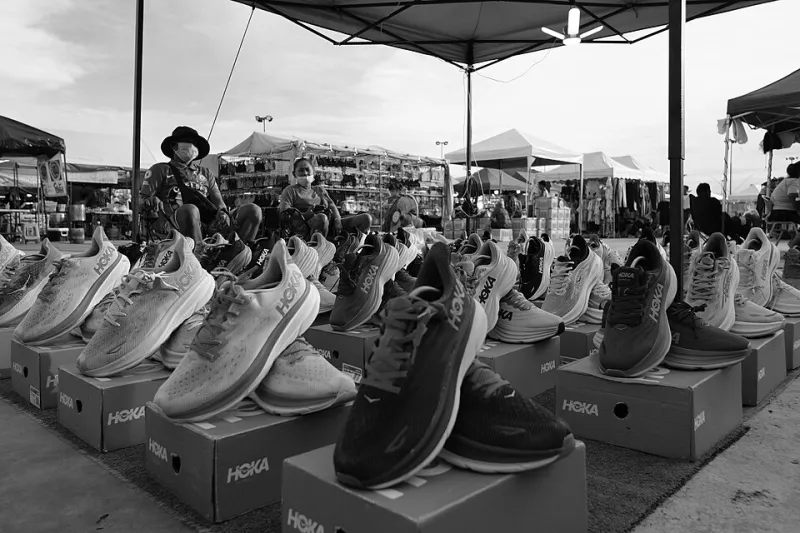
Photo: PattayaPatrol, CC BY-SA 4.0, via Wikimedia Commons
I've written a lot about buying HOKAs from Taiwan — the price gaps, the sizing quirks, the customs drama. But there's one question that shows up in my inbox more than any other: "If I import a pair and it doesn't fit, can I just resell it?"
Good question. So I ran the experiment. I bought three pairs of Taiwan-market HOKAs, listed them on StockX and eBay, and tracked every single dollar that came in and went out. The results were... educational.
The Three Pairs I Tested
To make this a fair fight, I picked three different scenarios:
Pair 1: The Asia-exclusive colorway. A Mach 6 in a muted jade-and-cream colorway that never hit US shelves. Bought for the equivalent of $148 USD including shipping.
Pair 2: The US-retail model, Taiwan price. A Bondi 9 in a standard black/white colorway that sells stateside too. Taiwan cost: about $122.
Pair 3: The sizing casualty. A Clifton 10 I ordered a half size too small because I got cocky with the conversion chart. Cost: $135.
The thesis: exclusive colorways should command a premium, standard colorways should basically break even, and the sizing mistake should be my control group for "worst case."
StockX: Clean, But It Costs You
StockX was my first stop for the jade Mach 6. The platform's big selling point is authentication and a friction-free experience — you ship, they verify, they pay.
I listed at $210 after watching comparable Asia-exclusive Mach sales for two weeks. It sat for nine days before a bid came in at $185, which I accepted.
Here's where the spreadsheet gets ugly:
- Sale price: $185
- StockX transaction fee (~9%): minus $16.65
- Payment processing (~3%): minus $5.55
- Shipping to their authentication hub: minus $14
Net: $148.80. Against my all-in cost of roughly $162 (shoe plus international freight plus a small customs brokerage fee), I actually lost about $13.
The exclusive colorway didn't flip for a profit — it just nearly broke even while giving me a fun story. HOKA is not Nike Dunks. The resale market for running shoes is thin, even for colorways people can't get domestically.
eBay: More Work, Better Margins
The Bondi 9 went to eBay, where I sold it as "New in Box, Taiwan market release, authentic with receipt." I answered maybe a dozen questions from suspicious buyers, which honestly fair — my own counterfeit hunt through Taipei's marketplace jungle taught me that gray-market listings deserve skepticism.
It sold for $139 after a week. eBay's fee structure (roughly 13% all-in for most sellers) took about $18, and shipping ran $16 with a padded box and tracking.
Net: $105. Against a $122 cost, that's a $17 loss.
The pattern was becoming clear: standard colorways bought in Taiwan sell for roughly what they'd cost used in the US — and the fees eat the price advantage you started with.
The Sizing Casualty: Predictably Brutal
The too-small Clifton 10 was the real-world scenario most importers face. Listed "new, never worn, box included" at $145, it got lowball offers in the $95–110 range for two weeks. Final sale: $118. After eBay's cut and shipping: $86 net.
That's a $49 loss on a $135 shoe. Ouch.
So What's the Takeaway?
If you're importing HOKAs from Taiwan purely as a flip, don't. The math doesn't work. Running shoes — even Asia-exclusives — don't have the resale culture that sneakers do, and platform fees will devour thin margins every time.
But here's the reframe that actually matters: resale value is your exit ramp, not your profit plan. If you import a pair for $130 less than US retail, wear it for 300 miles, and it doesn't work out, you can recoup most of your money. That's a safety net US-retail buyers don't get at full price.
My cost-of-ownership on the jade Mach 6, had I kept and run it, would've been excellent. The mistake was treating a great deal like a stock option.
Bottom line: Buy Taiwan HOKAs to run in them. Know that the resale floor exists — roughly 60–70% of what you paid after fees — and let that knowledge make bolder deals feel less risky. Just don't quit your day job to become a HOKA flipper. The spreadsheet says no.