After the Last Mile: Following a Dead HOKA Through a Taipei Repair-and-Recycling Loop
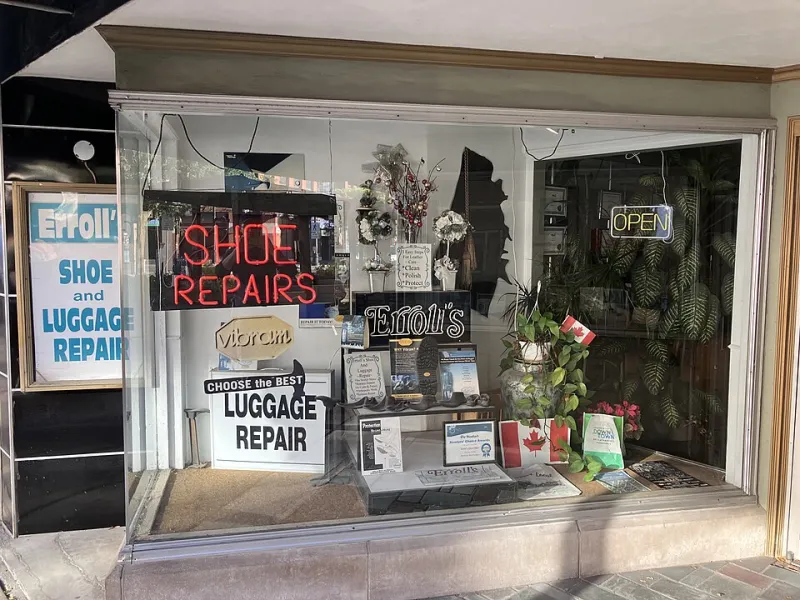
Photo: Gogerr, CC BY-SA 4.0, via Wikimedia Commons
The pair had 480 miles on it, a collapsed midsole, and a right shoe that listed left. In the U.S., that is a goodbye. In Taipei, it is a sorting problem. I dropped the shoes at a small repair-and-recycling shop near Shilin, the kind of place with a hand-painted sign, three sewing machines, and a stack of outsoles that looks like a tire shop had a yard sale.
Drop-off: the triage table
A clerk named Zheng looked at the foam first. He pressed his thumb into the midsole, flipped the shoe over, and checked the outsole wear pattern. Then he set the pair in one of three piles: repair, donate, recycle.
Mine went to repair, but not for running. The foam was dead. No cobbler in Taipei, or anywhere else, is bringing a compressed EVA midsole back to life. What they can do is make the shoe useful for walking. Zheng's bench replaced the insole, stitched a tear in the upper, and glued a rubber patch over the worn heel. The shoe came back as a grocery-store pair, not a training pair. That is the honest version of shoe repair. It buys time, not performance.
The repair bench
Taipei has a deep repair culture because people keep things longer. You see it with umbrellas, bags, and shoes. The shop does not treat a blown running shoe as a moral failure. It treats it as a decision: can this become a walking shoe, a work shoe, or a donation? If the upper is intact and the outsole has life, repair makes sense. If the foam is crushed and the upper is torn, it goes to the next pile.
Zheng showed me a rack of repaired HOKAs waiting for pickup. Some had new insoles. Some had stitched overlays. One had a resole that looked like a high-school shop project but probably added six months of dog-walking duty. The shop charges by the job, not by the brand. A basic patch and insole replacement costs less than a new pair of budget trainers, which is the entire point.
The donation pile
Repaired shoes that are still wearable but not sellable go to donation partners: a local run club, a community center, and a group that outfits migrant workers. The shop cleans them, pairs them by size, and stores them in labeled bags. It is not a drop-off free-for-all. Someone checks the shoes first, which is why the donation pile is not just landfill with good intentions.
That matters for U.S. runners because shoe drives often collect first and sort later. Here, sorting comes first. If a pair is too far gone, it does not get donated just to make the donor feel better. It goes to recycling.
The recycling pile
At the back of the shop, there are sacks of rubber outsoles, foam midsoles, and textile uppers. The rubber goes to a local material-recovery partner. The foam is harder. Not all midsoles can be ground and reused, and the shop is upfront about that. Some foam becomes padding or filler. Some goes to waste-to-energy. The goal is not a perfect circular economy. The goal is to keep the shoe out of the trash long enough for the useful parts to be pulled out.
Taiwan's recycling culture helps. The city has collection points and a public habit of separating materials. But the shop owner was clear: running shoes are not a simple recycling stream. They are a bundle of glued materials. The best environmental move is still to wear them longer, repair them once, and then sort them properly.
What Taiwanese runners actually do
Most runners I know here do not toss a shoe the moment the foam feels flat. They rotate pairs, use aftermarket insoles, and keep a retired pair for walking. They also buy at outlets and repair shops instead of treating every shoe as disposable. That is not a virtue signal. It is a budget strategy. Taipei runners are practical. If a shoe can become a commute shoe, it becomes a commute shoe.
How to copy this in the U.S.
Do not ship your dead HOKAs to Taipei. That misses the point and adds carbon. Copy the sequence instead.
First, find a local cobbler who will work on athletic shoes. Ask specifically for a walking-shoe repair, not a running-shoe rebuild. Second, donate only shoes that are clean and still wearable. Call the run club or shelter first. Third, use municipal textile recycling for the shredded pairs, and check whether your city accepts shoes as textiles rather than trash. Fourth, ask HOKA about warranty or outsole wear programs before you give up. Fifth, keep one retired pair for errands. You will use it more than you think.
The Taipei shop did not save my old HOKAs. It extended their life by a few months, then sorted them honestly. That is a better ending than the closet. And it is a habit you can start in Seattle, Austin, or Baltimore without a passport.